
[interactive_buttons]
The Legacy of the Nilgiri Mountain Railway (NMR)

Welcome to backup.train360.co.in/, your reliable portal for railway history, heritage lines, and scenic train journeys across India. In this article, we invite you on a fascinating journey through time, landscapes, and engineering skill. This is the story of the Nilgiri Mountain Railway (NMR) in Tamil Nadu. From colonial dreams and engineering feats to UNESCO heritage status and modern challenges, we cover all you need to know. We explore why this mountain train still warms hearts today.
1. Introduction of Nilgiri Mountain Railway history – Why the NMR matters
The Nilgiri Mountain Railway is not just a train ride. It’s a living icon of railway heritage in India. Built to climb the misty heights of the Nilgiri Hills, it treats riders to sweeping views of tea estates, forests, and rocky slopes. It combines scenic beauty with technical skill.
For our readers at backup.train360.co.in/, this story aligns with our goal of celebrating railway history, engineering, and travel experiences. You can also read our related post: Konkan Railway History.
2. Origins: Planning and Early Years
The story begins in the mid-19th century. In 1854, someone proposed building a railway from the plains of Mettupalayam to the Nilgiri Hills. However, the tough terrain and bureaucratic delays slowed progress.
- 1870s – Swiss engineer Niklaus Riggenbach suggested a rack system for the climb.
- Construction started around 1891.
- On 15 June 1899, the line from Mettupalayam to Coonoor opened for traffic.
- It was extended to Fernhill and Ooty (Udhagamandalam) by October 1908.
This laid the groundwork for one of India’s most remarkable mountain railways.
3. Route & Engineering: Climbing the Blue Mountains
The Nilgiri Mountain Railway stretches about 46 km from Mettupalayam to Ooty, reaching an altitude of over 2,200 m.
- Metre-gauge track (1000 mm) throughout.
- Uses a rack-and-pinion (Abt system), the only one of its kind in India.
- Maximum gradient: 1 in 12 (≈ 8.3%).
- Includes 16 tunnels, 250+ bridges, and 200+ sharp curves.
- Altitude gain: 330 m to 2,200 m in just 46 km.
The engineering behind NMR remains unmatched, blending human creativity with the beauty of the Nilgiri landscape.
4. Steam Engines, Rolling Stock & the “Toy Train” Charm
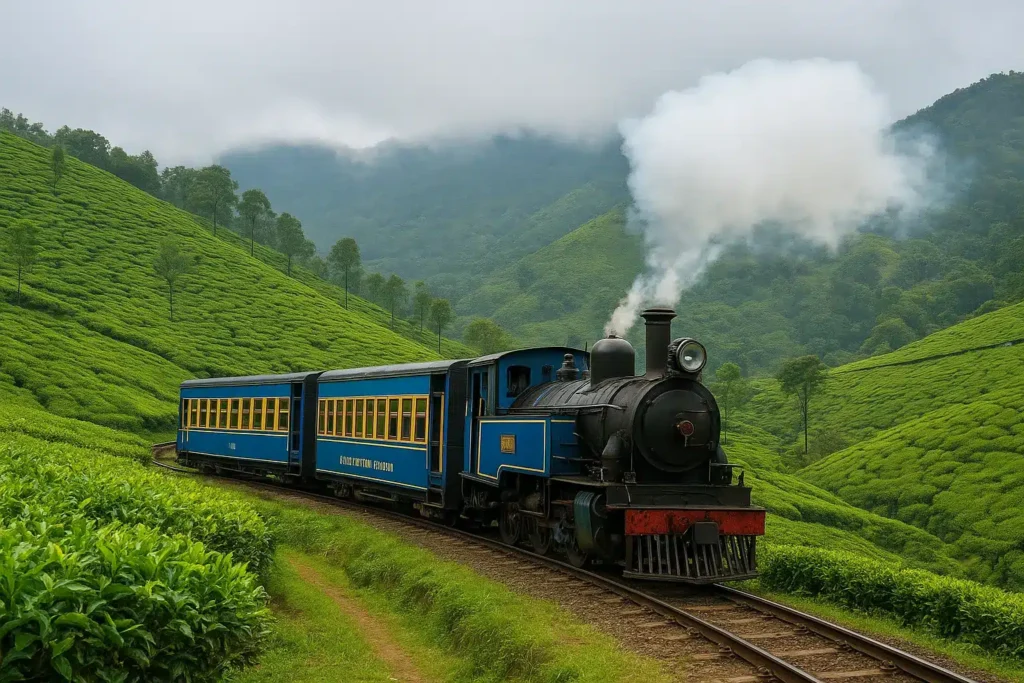
The Nilgiri Mountain Railway is known for its heritage steam locomotives, especially in the steep rack section. Its slow speed and vintage cars give it the nickname “toy train.”
- The rack section (Mettupalayam–Coonoor) uses special “X Class” steam locomotives made by Swiss Locomotive & Machine Works, Winterthur.
- Beyond Coonoor, diesel engines are used since the gradient becomes gentler.
- The journey offers nostalgic charm — steam whistles, misty valleys, and stunning views.
For visitors, it’s a blend of time, sound, and nature — not just transport.
5. Heritage Status & Cultural Significance
In July 2005, the Nilgiri Mountain Railway was named a UNESCO World Heritage Site as part of the “Mountain Railways of India.”
This recognition highlights its outstanding universal value, a mix of engineering, culture, and scenic importance. The NMR, along with the Darjeeling and Kalka-Shimla railways, represents India’s pioneering railway spirit.
This railway is also a key symbol for the Nilgiri region, reflecting its colonial history and tourism appeal.
6. Route Today – Travel Experience & Tips
Location: Tamil Nadu, India – between Mettupalayam (Coimbatore District) and Ooty (Nilgiris District).
Distance: 46 km | Duration: 4–5 hours uphill.
Highlights: Scenic bridges, tunnels, waterfalls, and tea plantations.
Travel Tips:
- Best time to visit: October–March for clear skies.
- Book tickets in advance, especially on weekends or holidays.
- Bring a camera; every curve is a chance for a photo!
- Nearest city: Coimbatore (train or bus to Mettupalayam).
Also read: Konkan Railway History on our website.
7. Significance for Local Economy & Tourism
The Nilgiri Mountain Railway plays a crucial role in tourism and local jobs.
- It boosted hill-station tourism since the British era.
- It provides jobs in workshops, stations, and tourism services.
- It supports heritage preservation and local cultural identity.
Today, the NMR remains essential for Ooty’s tourism economy, attracting thousands of visitors each year.
8. Challenges & Future Prospects
- Maintenance: Steam engines and rack systems need special expertise.
- Environmental challenges: Landslides and monsoon disruptions affect service.
- Preservation vs modernization: Balancing tourism growth with conservation.
- Future: Station renovations and promoting digital heritage while keeping the historic essence.
9. Conclusion
The Nilgiri Mountain Railway is more than just a transportation line; it’s a living monument of India’s railway heritage. Since 1899, it has symbolized engineering excellence and harmony with nature.
If you love trains or plan to visit Ooty, don’t miss this UNESCO-listed treasure. Experience the magic of steam, mist, and mountains — it’s a journey through history itself.
Read more: Konkan Railway History